Buying guide · 8 min read
Fly fishing starter kit: rod weight, line and the first flies to buy
A 9-foot 5-weight, a floating line, a leader and a small box of flies. What each piece does and the sizes to start with.
Updated
First Cast Fishing earns a commission when you buy through links on this site, at no extra cost to you. Affiliate disclosure
Fly fishing has its own vocabulary, and that is most of what makes it look hard to start. Once you know what rod weights, line tapers and X-sized tippets mean, the kit is short. This guide covers the rod, the line, backing, leader and tippet, the reel, a first box of flies and the small tools for your vest. The focus is trout and panfish in rivers, streams and ponds, which is where most people cast a fly first.
Rod weight: start with a 9-foot 5-weight
Fly rods are sized by "weight," a number from 0 to 14 or so that matches the rod to a line of the same weight. A light number throws small flies gently; a heavy number throws big, wind-resistant flies and fights bigger fish.
The 9-foot 5-weight is the standard first rod. It casts dry flies softly enough for trout, handles a small streamer or a weighted nymph, protects light tippet, and still punches a cast into a breeze on a lake.
When to go lighter or heavier:
| Rod weight | Typical length | Where it fits |
|---|---|---|
| 3–4 weight | 7–8.5 ft | Small, brushy creeks, small trout, panfish, small dry flies |
| 5 weight | 9 ft | Trout in most rivers and lakes; the all-round start |
| 6 weight | 9 ft | Bigger rivers, wind, heavier nymph rigs, small bass bugs |
| 7–8 weight | 9 ft | Bass with large poppers, carp, steelhead, light saltwater |
Shorter rods are easier under overhanging trees; 9 feet gives you more reach to lift line off the water and mend it. Most rods now come in four pieces, which travel well in a car or a pack.
Buying a rod, reel and line as a matched outfit removes the guesswork for a first setup. The Orvis Encounter outfit is a 9-foot, 5-weight, four-piece rod sold with a reel and line matched to it, which is the configuration this guide recommends. Browse fly fishing combos for other outfits, including 3/4-weight kits for small streams, or fly rods on their own.
Fly line: weight forward and floating
In fly fishing the line is the weight you cast; the fly weighs almost nothing, so the line matters more than in any other kind of fishing.
Fly line boxes carry a short code. WF-5-F means weight forward, 5-weight, floating:
- WF (weight forward): the heavy part of the line sits near the front, so it loads the rod quickly and carries the fly out. This is the taper to start with. DT (double taper) lines are even along a long middle section and land very softly, but they take more practice to cast far.
- 5: the line weight. Match it to the rod. A 5-weight rod takes a 5-weight line.
- F (floating): the whole line floats. S is full sinking, I is intermediate (sinks slowly), and F/S is a floating line with a sinking tip.
A floating line covers dry flies, nymphs under an indicator, and streamers in shallow water. Sinking lines are for lakes and deep streamer fishing, and can wait. If your outfit did not include a line, or you want to replace the one it came with, the Scientific Anglers Air Cel WF-5-F is a weight-forward floating 5-weight. See fly line and backing for other weights and tapers.
Backing: the line under the line
Backing is thin braided line wound onto the reel first, under the fly line. It fills the spool so the fly line sits in larger coils, and it gives a running fish somewhere to go once the 80 to 100 feet of fly line is off the reel.
- Trout and panfish: 50 to 100 yards of 20 lb Dacron on a 4- to 6-weight reel.
- Bass, steelhead and saltwater: 20 or 30 lb backing, and as much as the reel holds, often 150 yards or more.
Few trout take you into the backing, but outfits usually come with it spooled.
Leaders and tippet: the X system
A leader is a tapered length of clear monofilament between the fly line and the fly. It starts thick at the butt, where it joins the line with a loop-to-loop connection, and narrows to a thin end. The taper turns the fly over at the end of the cast so it lands straight. A 9-foot leader is the default; use 7.5 feet on small streams.
Tippet is the thin last section, tied on to the leader's end. Each time you change flies you use up a little of it, so you add new tippet from a spool instead of cutting into the leader.
Leaders and tippet are sized with an X number. The higher the X, the thinner the line. A handy rule: subtract the X from 11 to get the diameter in thousandths of an inch, so 4X is 0.007 inch and 6X is 0.005 inch. Breaking strength at each size varies by brand and material.
| Size | Diameter | Typical use |
|---|---|---|
| 2X–3X | 0.009–0.008 in | Streamers, big nymphs, bass bugs, size 4–10 flies |
| 4X | 0.007 in | General trout fishing, size 10–14 flies |
| 5X | 0.006 in | Smaller dries and nymphs, size 14–18 flies |
| 6X–7X | 0.005–0.004 in | Tiny flies and clear, slow water, size 18–24 |
Another rule of thumb: divide the fly's hook size by 3 to get the tippet X. A size 12 fly goes on 4X, a size 18 on 6X. Treat it as a starting point and go heavier when the fish are big or the water is colored.
For a first kit, buy a few 9-foot 4X leaders and spools of 4X, 5X and 6X tippet. The RIO Powerflex trout leaders are 9-foot, 4X tapered leaders with a loop at the butt, and the RIO Powerflex tippet three-pack holds 4X, 5X and 6X spools, which covers the sizes above. More choices are in fly leaders and tippet.
To join tippet to leader, a double surgeon's knot is the common choice (a blood knot also works); to tie on the fly, an improved clinch knot. Our guide to the five fishing knots to learn first covers the clinch.
The reel
For trout, a fly reel mostly stores line. You strip line in by hand and play most fish that way, so drag matters less than on a spinning reel. What to look for:
- A size that matches the line: a reel marked 5/6 holds a 5- or 6-weight line plus backing.
- A large arbor: a wide spool center picks up line faster and leaves the line in larger coils, so it comes off the reel straighter.
- A smooth, adjustable drag: it becomes important for bigger fish, and a sealed drag matters in saltwater.
If you buy a reel separately, see fly reels.
A first fly box
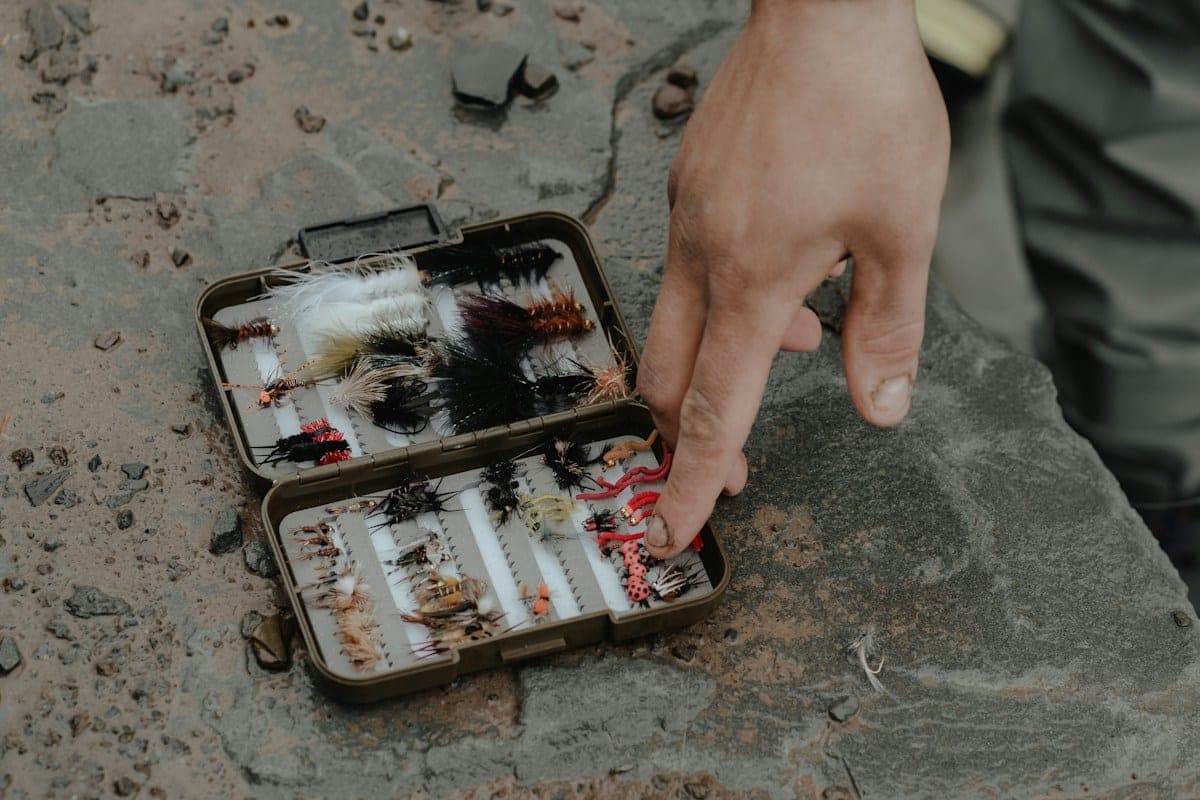
There are thousands of patterns, but a handful catches fish in most trout water. Buy two or three of each in a couple of sizes, because you will lose some in trees.
Dry flies float on the surface and imitate adult insects. Fish them on 5X tippet with floatant.
- Parachute Adams, sizes 12–18: a general mayfly look with a white post you can see on the water.
- Elk Hair Caddis, sizes 12–16: floats well in faster water.
- A foam hopper, sizes 8–12, for late summer along grassy banks.
Nymphs sink and imitate insect larvae and other underwater stages, which make up much of what trout eat. Fish them under a strike indicator.
- Beadhead Pheasant Tail, sizes 14–18.
- Beadhead Hare's Ear, sizes 12–16.
- Zebra Midge, sizes 18–20, for tailwaters and winter.
The beadhead Pheasant Tail assortment holds 12 flies across sizes 12 to 18, which spans the Pheasant Tail sizes above.
Streamers imitate small fish, leeches and crayfish. Strip them back in short pulls. A Woolly Bugger in olive or black, sizes 6–10, catches trout, bass and panfish, and is the fly to tie on when nothing is rising.
Wet flies are swung across and down the current on a tight line. Soft-hackle patterns in sizes 12–16 are an easy way to start, since the current does most of the work.
For bluegill in ponds, add a few small poppers in sizes 8–12; bass take larger bugs, around sizes 2–6, which cast more easily on a 6- or 7-weight. Browse dry flies, nymphs, streamers and wet flies, and keep them in a small fly box.
Small tools that earn their place
These hang from a vest, a sling pack or a lanyard so they are in reach while you stand in the water:
- Nippers for trimming tippet and tag ends.
- Forceps for removing hooks from deep in a fish's mouth and for pinching down barbs.
- Floatant, a gel or a desiccant powder, to keep dry flies riding high. Shake powder works on a fly that is already wet.
- Strike indicators for nymph fishing.
All of these are in fly accessories, with nippers and forceps and floatants in their own sections.
The starter checklist
- A 9-foot 5-weight rod and a 5/6 reel, or a matched outfit.
- WF-5-F floating line on 50 to 100 yards of 20 lb backing.
- Three 9-foot 4X leaders.
- Tippet spools in 4X, 5X and 6X.
- A dozen dry flies, a dozen nymphs and a few Woolly Buggers.
- Nippers, forceps, floatant and a few strike indicators.
Add a fishing license, polarized glasses and a hat for eye protection while casting, and you are ready for the water.