Technique · 8 min read
Bucktail jigs for inshore saltwater
Head shapes, weights, colors and trailers for fluke, striped bass, redfish and snook, from the beach or the boat.
Updated
First Cast Fishing earns a commission when you buy through links on this site, at no extra cost to you. Affiliate disclosure
A bucktail jig is a lead head, a strong hook and a skirt of deer hair tied around the collar. It has caught striped bass, fluke, redfish and snook for generations because it does so much with so little: it sinks fast, holds bottom in current, and the hair breathes even when the jig sits still. This guide covers head shape and weight for your depth and current, colors, trailers, and how to work it for the four species most inshore anglers chase.
Head shapes
The head decides how a bucktail sinks, how it moves when you snap it, and how well it holds in current. Most heads fall into three groups.
- Round or ball heads. The all-round shape. They sink quickly, fall straight and bounce well along a sandy or shell bottom. A good first choice for fluke and for redfish in channels.
- Bullet and torpedo heads. A pointed nose that cuts through moving water. They hold the bottom in strong current with less weight than a round head, so they suit inlets, rips and deep channels.
- Flat-sided and banana heads. A wider, flatter profile that glides and darts on the drop instead of falling straight down. They suit swimming a jig through the middle of the water column for striped bass and snook, and many anglers find they hang up less over rock than a round head.
Hook quality matters as much as the head. Look for a strong, sharp hook, from about 1/0 on light flats jigs to 7/0 on heavy ones, and check the point before every trip; sand and shell dull it. The Spro Prime Bucktail Jig is a 1 oz jig with a Gamakatsu hook and a glow finish, a weight that covers a lot of fluke and striped bass water.
Choosing the weight
The rule is simple: fish the lightest jig that still reaches the bottom and lets you feel it. A lighter jig falls more slowly, looks more natural and snags less. When you lose touch with the bottom, go up a size.
| Water | Typical weight |
|---|---|
| Shallow flats, 1–5 ft, little current | 1/8–3/8 oz |
| Bays, creek mouths and docks, 5–15 ft | 3/8–3/4 oz |
| Inlets and channels, 15–30 ft, moderate current | 3/4–2 oz |
| Deep rips, ocean structure, strong tide or wind | 2–4 oz and up |
A fast drift, a strong tide or thick braid all push you heavier, and the same spot may need a 1 oz jig at slack tide and a 2 oz jig at peak flow. Carry at least three weights in your main size range. The OROOTL bucktail jigs come in weights from 1/4 oz to 2 oz, enough of a spread to change with the tide. For shallow redfish and snook, the light end of that range lets the hair drift down slowly over grass and sand.
Colors
White catches fish everywhere and is the color to buy first: it looks like the baitfish, squid and shrimp most inshore predators eat. After that:
- Chartreuse and white-and-chartreuse for stained water, overcast days and dusk.
- Pink for fluke, a traditional color for them, and for clear water in bright sun.
- Yellow for striped bass, especially around rocks and jetties.
- Black or purple at night and in muddy water, where a dark silhouette stands out most clearly against the sky.
Most anglers carry white in several weights and add one or two of the others. For more on picking a color by the water, read matching lure color to water clarity.
Tipping with a trailer
A bare bucktail catches fish, but a trailer adds length, a tail that kicks on every hop, and often scent.
- Soft-plastic grub or paddle tail. Thread a 3- to 5-inch grub or paddle-tail swimbait onto the hook so it sits straight behind the hair. The Berkley Gulp! Grub is a scented 4-inch curly-tail grub; on a fluke jig the tail swims on the drop and the scent can hold a fish on the bait a little longer.
- Natural strip. A strip of squid, or a 4- to 5-inch strip cut from the belly of a fluke or a sea robin, hooked once through the narrow end so it flutters. Legal sizes and rules on using fish for bait vary, so check your local regulations.
- Shrimp tail. For redfish, spotted seatrout and snook, a soft-plastic shrimp body or a shrimp imitation tail fits the forage on most southern flats.
Keep the trailer straight: a crooked one spins the jig and twists the line. If short strikes are pulling the tail off, use a shorter trailer rather than a longer one.
Working the jig, species by species
Every bucktail technique comes back to the same motion: let it fall to the bottom, lift it with a short snap of the rod tip, then follow it back down on a semi-tight line. Most strikes come on the fall, often as a tap or simply as weight on the line when you lift. Set the hook on anything that feels different.
Fluke (summer flounder)
Fluke lie flat on the bottom and ambush bait that passes overhead, so the jig has to stay in their zone. Drift over sand, shell and structure edges, and keep the jig bouncing along the bottom with short, steady hops. A fluke often grabs the bait and then repositions it, so if you feel a hit and miss, drop the jig straight back.
Many fluke anglers fish a high-low rig: the bucktail on the bottom and a small teaser on a dropper loop 18 to 24 inches above it. A bucktail teaser like the green Last Cast Tackle teaser on a 5/0 hook, tipped with a short soft-plastic strip, gives fish a second target at a different height.
Striped bass
Striped bass feed in current and around rock. From a jetty or a beach, cast up-current at an angle, let the jig sink until you feel the bottom or until it sweeps into the strike zone, then retrieve with lifts and drops as the tide carries it. From a boat, drift through rips and over ledges and work the jig the same way you would for fluke, but higher off the bottom. At night, a slow, steady swim with a dark jig often outfishes the hop.
Redfish
Redfish feed on crabs and shrimp along the bottom, so a bucktail that kicks up puffs of sand looks like food. On shallow flats, use the lightest jig you can cast, 1/8 to 1/4 oz, and hop it slowly across potholes and grass edges. In deeper channels and around docks, step up to 1/2 to 3/4 oz and keep it on the bottom.
Snook
Snook hold around current breaks: bridge pilings, dock lights, mangrove points and inlet jetties. Cast up-current and let the tide sweep the jig past the structure, working it with sharp snaps. Night tides around lights and bridges are worth fishing. Snook have abrasive mouths and run hard for cover, so they demand a heavier leader than the other species here.
Jigging from shore and boat
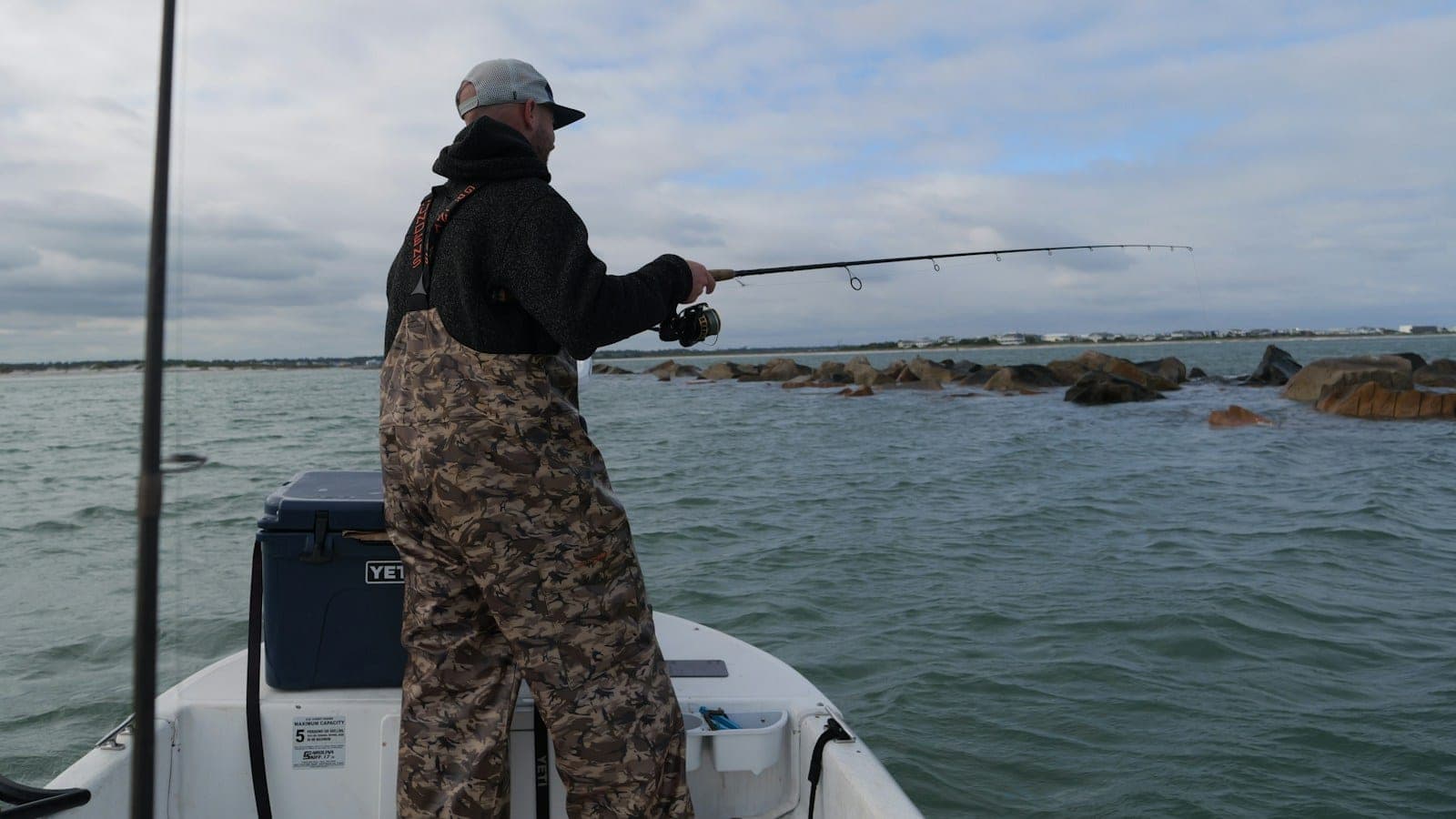
From shore (beaches, jetties, inlets and piers), distance and snag control matter most. A 7½- to 9-foot spinning rod casts farther and keeps line off rocks. Over rock, choose a flat-sided or bullet head, which hangs up less, and expect to lose some jigs.
From a boat, you can drift directly over fish and fish the jig more vertically. A 6½- to 7-foot rod is easier to work all day, and a conventional reel with a thumb on the spool helps you drop a heavy jig straight to the bottom in deep water. Use the trolling motor or a drift sock to slow a fast drift instead of adding more weight.
Rod, line and leader
- Rod: a 7-foot medium to medium-heavy, fast-action spinning rod with a lure weight of about 1/2 to 2 oz covers most inshore bucktailing. Go lighter for flats, heavier for deep rips.
- Main line: 15 to 30 lb braid. Braid has almost no stretch, so you feel the bottom and the bite, and its thin diameter sinks faster and resists the current less than monofilament.
- Leader: 2 to 4 feet of fluorocarbon. Use about 20 lb for fluke and redfish in clear water, 30 to 40 lb for striped bass around rock, and 30 to 50 lb for snook. The Seaguar Blue Label fluorocarbon leader in 20 lb suits fluke and redfish; browse leader material for heavier tests.
Tie the jig on with a loop knot rather than a clinch knot so the jig swings freely and falls more naturally. For the knots to join braid to fluorocarbon and tie a loop, see five fishing knots to learn first and swivels, snaps and leaders. For more on line choice, read mono, fluoro or braid: picking fishing line.
A starter set
- White round-head bucktails in three weights that match your water, for example 1/2, 1 and 1 1/2 oz.
- Two or three in chartreuse or pink.
- A pack of 4-inch soft-plastic grubs or paddle tails for trailers.
- A few bucktail teasers if you fish for fluke.
- A spool of fluorocarbon leader.
Browse saltwater bucktail jigs and the wider range of hair jigs and bucktails, then add weights and colors as you learn your water.