Seasonal · 7 min read
How to fish a jerkbait in cold water
Suspending or floating, how long to pause, the line and rod that suit it, and how to tune and weight a jerkbait for 40-degree water.
Updated
First Cast Fishing earns a commission when you buy through links on this site, at no extra cost to you. Affiliate disclosure
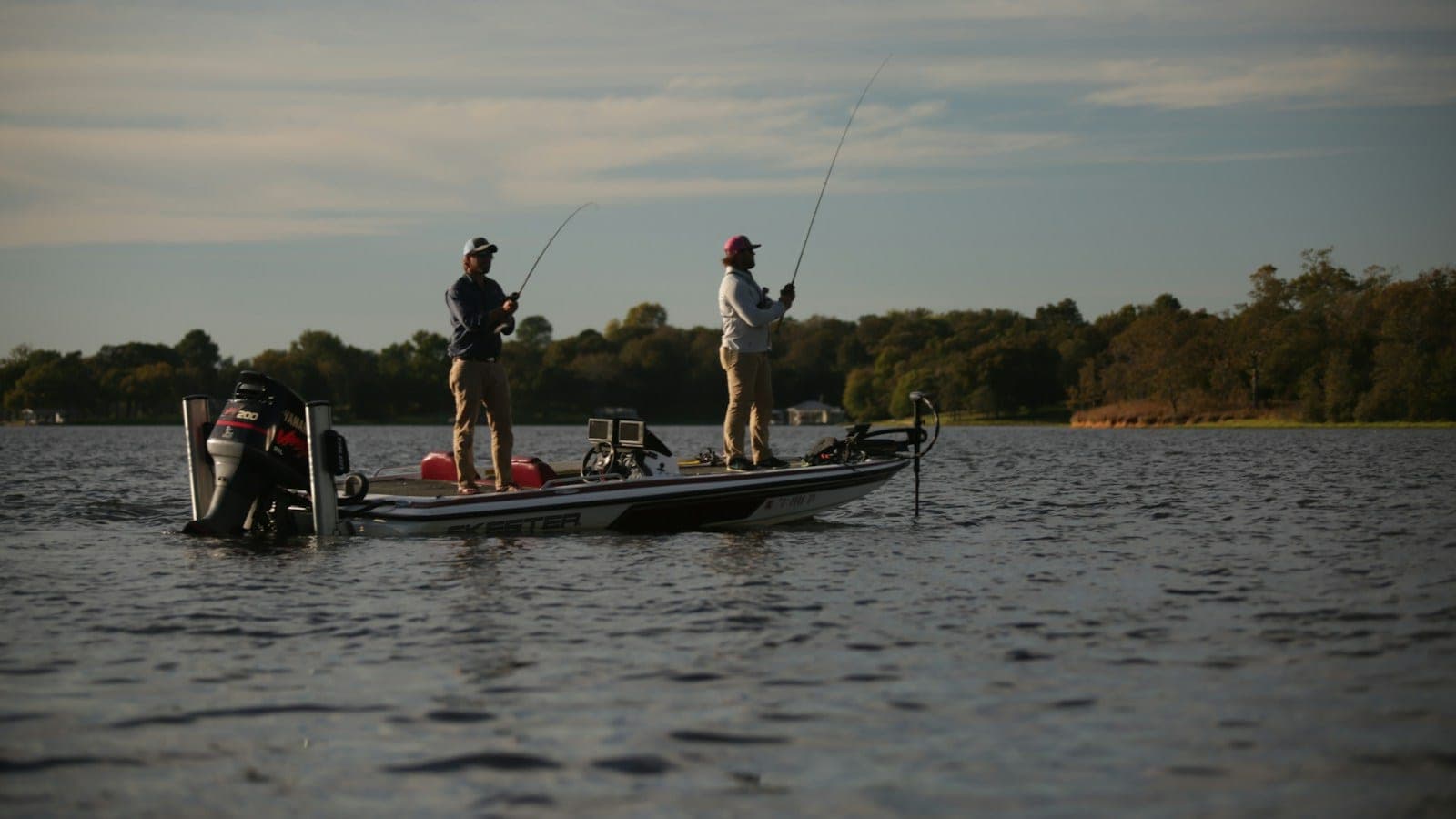
When the water drops into the 40s, bass slow down, hold in one place and rarely chase, and many of the baits that worked in summer go quiet. A jerkbait is one of the few lures that still draws strikes, because it can hang in front of a cold fish, nearly motionless, for as long as you let it. This guide covers suspending and floating jerkbaits, the water temperatures where they shine, the twitch-twitch-pause cadence and how long to pause, the line and rod to use, and how to tune and weight a jerkbait so it behaves in cold water.
What a jerkbait is
A jerkbait is a long, slim minnow-shaped hard bait with a small lip, usually 3 to 5 inches long with two or three treble hooks. Reeled steadily it swims with a gentle wobble, but that is not how it is fished. Snapped with the rod tip, it darts sharply to one side, flashes and stops. That dart-and-stop looks like a dying baitfish, an easy meal for a fish that does not want to spend energy.
Suspending or floating
Suspending jerkbaits are weighted to be close to neutrally buoyant. Stop reeling and they stay at the depth they reached, hanging in place. That pause is the whole point in cold water: a sluggish bass can drift up and look at the bait for several seconds before it decides. Suspending models are the default from late fall to early spring.
Floating jerkbaits rise slowly when you stop. They suit warmer water, shallow fishing over grass, and twitching on the surface. In cold water they rise away from fish too quickly unless you weight them (see below).
The Rapala X-Rap in the 4-inch XR10 size is a suspending jerkbait, a common size for largemouth and smallmouth.
For clear water and pressured fish, a smaller bait often draws more strikes. The Lucky Craft Pointer 78SP is a 3-inch suspending jerkbait ("SP" means suspending).
Shallow or deep
Most standard jerkbaits run 2 to 6 feet down. Deep-diving models with longer lips reach 8 to 12 feet, which matters when cold fish sit on bluffs, steep points and channel edges. The Strike King KVD 300 Deep Jerkbait is a 4.75-inch suspending jerkbait with a long lip for that deeper water. Browse more in suspending jerkbaits.
The water temperatures where it shines
Jerkbaits catch fish all year, but they come into their own in cold, clear water.
| Water temperature | What fish do | Jerkbait approach |
|---|---|---|
| Below 40°F | Very slow; many hold deep | Deep jerkbait, very long pauses (15 to 30 seconds), or switch to a jig or blade bait |
| 40 to 45°F | Slow, but will rise to a bait | Long pauses, 8 to 20 seconds |
| 45 to 50°F | Starting to feed again | Pauses of 3 to 10 seconds |
| 50 to 55°F | Prespawn, moving toward shallow water | Shorter pauses, 1 to 4 seconds, more aggressive jerks |
| Above 55°F | Active | Many anglers switch to faster baits, but a jerkbait still works around spawning areas |
These numbers are starting points. Practice varies a great deal by lake and by angler.
Clarity matters as much as temperature. A jerkbait is a sight bait, and it needs visibility of about 3 feet or more. In muddy water, fish cannot see it hanging; a bait with vibration, like a lipless crankbait or a slow-rolled spinnerbait, suits that better. See how to choose a crankbait by depth and spinnerbaits vs. chatterbaits vs. buzzbaits.
Where to fish it: points, the first drop off a spawning flat, bluff walls, rocky banks, and the edges of standing timber. In late winter, a sunny afternoon that warms a north bank by a couple of degrees can pull fish up.
Twitch, twitch, pause
- Cast and dive. Make a long cast, then reel 4 to 6 quick turns to pull the bait down to its running depth.
- Twitch. With the rod tip pointed at the water, snap it down sharply, a short movement of 6 to 12 inches. The snap should go into slack line, so the bait darts and stops rather than being dragged forward.
- Twitch again. Take up the slack and snap a second time.
- Pause. Stop. Leave the bait completely still, with a slight slack bow in the line.
- Repeat. Vary the number of twitches, two, then three, then one, until a pattern draws strikes.
How long to pause
The colder the water, the longer the pause. In the low 40s, count to 10 or more; some anglers wait 20 seconds or longer. In the 50s, one to three seconds is often enough. If you are not getting bites, double the pause before you change anything else.
Most strikes come during the pause or on the first twitch after it. Bites are often subtle: the line jumps, goes slack, or the next twitch feels heavy and soft. Set the hook with a firm sweep at any change.
Line and rod
Fluorocarbon line is the standard choice. It sinks, which helps the bait reach its full depth and stay there on the pause, and its low stretch transmits a crisp twitch to the bait. Use 8 to 12 lb test; thinner line lets the bait run deeper and dart more freely. Seaguar InvizX is a fluorocarbon line, here in 8 lb, a weight that suits smaller jerkbaits and clear water.
Monofilament sinks very slowly and can lift a suspending bait on a long pause, so keep it for floating jerkbaits in shallow water. Braid with a fluorocarbon leader works on a spinning reel, but braid's lack of stretch can tear treble hooks out of a fish that thrashes near the boat. For more, see mono, fluoro or braid.
Rod: a 6'6" to 7'0" medium-power rod with a fast or moderate-fast action, casting or spinning. A shorter rod keeps the tip from slapping the water when you twitch downward. The tip should have some give so treble hooks stay pinned, as rod power and action explains.
Reel: a baitcaster around 6:1 to 7:1, or a 2500-size spinning reel for smaller baits and lighter line.
Tuning a jerkbait that runs to one side
A jerkbait that swims off to the left or right on a straight retrieve will not dart evenly, and it will not stay in the strike zone. Tune it before you fish it.
- Make a short cast and reel quickly. Watch which way the bait drifts.
- With needle-nose pliers, bend the line tie (the eye on the lip) a tiny amount in the opposite direction. If it runs left, bend the eye to the right.
- Cast and check again. Make small adjustments; a hair's width at a time is enough.
Also check that the split ring is not caught in the eye, and that the hooks hang freely. A bent hook can pull the bait off line too.
Weighting a jerkbait
Cold water is slightly denser than warm water, and baits vary from one to the next, so a jerkbait sold as suspending may rise slowly at 40°F. Some anglers want a bait that holds perfectly still; others want a very slow rise or sink. You can adjust it.
- Adhesive weights. Small lead or tungsten dots or strips stick to the belly. Add one at a time and test.
- Heavier hooks. Swap the trebles for the next size up, or a heavier wire. This adds weight without changing the look much. Browse treble hooks.
- Larger split rings. A size larger adds a little weight at each hook.
Where you add weight changes how the bait sits. Weight near the front tips the nose down; weight in the middle keeps it level; weight behind center lifts the nose. A level or slightly nose-down posture suits most cold-water fishing.
Test it at the boat or in a bucket filled with water at the temperature you fish: twitch the bait down a foot, stop it and watch for 10 seconds. It should hang still or drift very slowly.
The Smithwick Rattlin' Rogue is a 4.5-inch floating jerkbait. With a weight or two on its belly, a floater like this can be made to suspend.
Color
In clear water, start with natural and translucent colors (ghost minnow, shad, clear with a dark back). On sunny days, chrome and silver flash. In slightly stained water, add some chartreuse or firetiger. See matching lure color to water clarity.
A cold-water jerkbait kit
- Two suspending jerkbaits around 4 inches, one natural and one bright.
- One smaller suspending jerkbait for clear water.
- One deep-diving jerkbait for bluffs and steep banks.
- A spool of 8 to 10 lb fluorocarbon.
- Adhesive weights and a pair of needle-nose pliers.
Browse all jerkbaits and dress warmly: a jerkbait pays off for anglers patient enough to wait out the pause on a cold day.