Technique · 8 min read
Spinnerbaits vs. chatterbaits vs. buzzbaits
Three bladed baits, three different jobs. What each blade does, and the water, cover and temperature where each one fits.
Updated
First Cast Fishing earns a commission when you buy through links on this site, at no extra cost to you. Affiliate disclosure
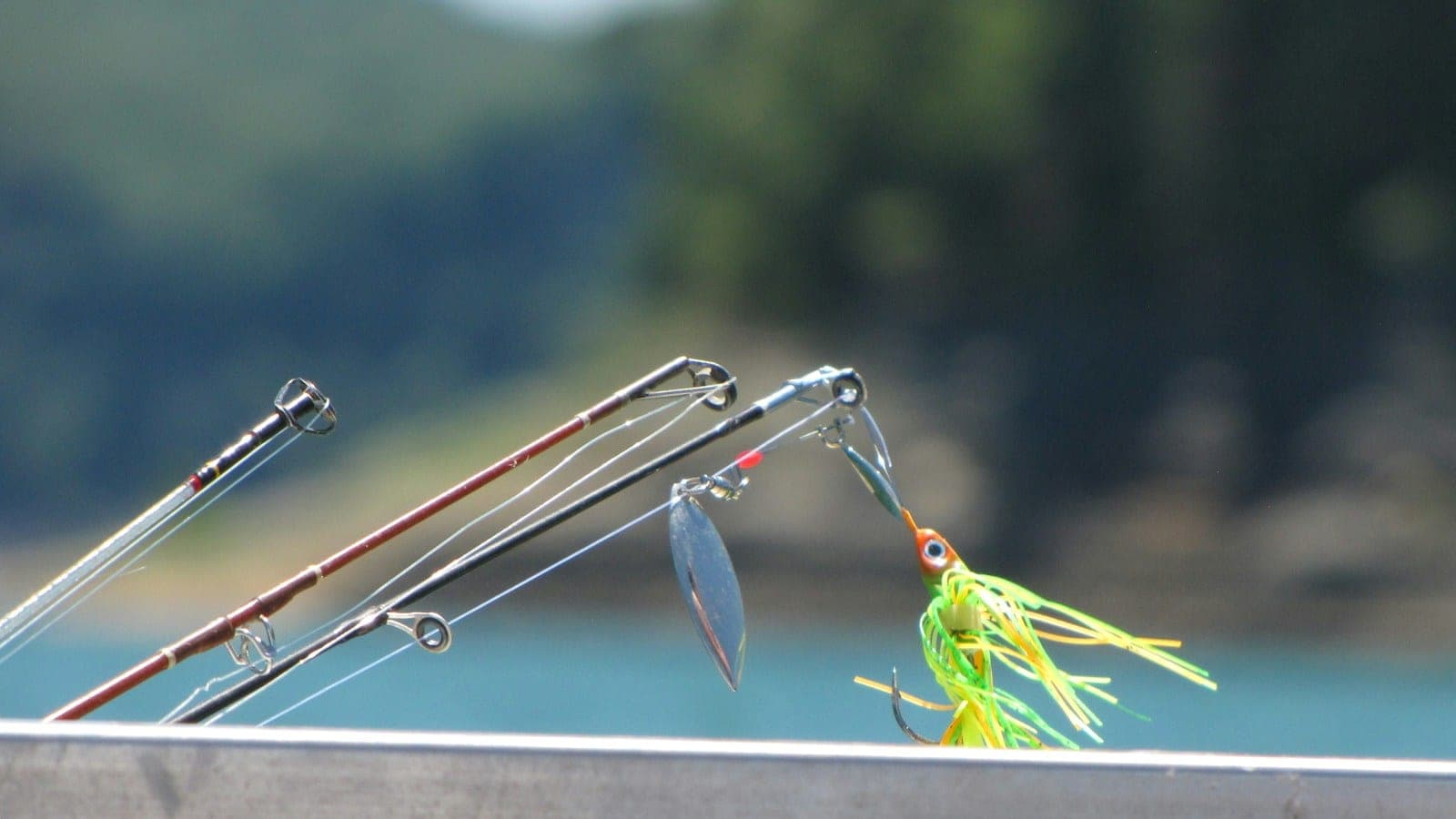
Spinnerbaits, chatterbaits and buzzbaits all use a metal blade to draw fish in, and all three catch bass from spring to late fall. But the blades work in very different ways. One spins and flashes, one swings and thumps, one churns the surface. This guide explains what each blade does, the water clarity, cover and temperature that suit each bait, how to retrieve them, and how to add trailers and trailer hooks. Inline spinners, the small trout and panfish version, get a short section at the end.
The three baits at a glance
| Bait | Where it runs | What draws fish | Cover | Water temperature |
|---|---|---|---|---|
| Spinnerbait | Surface to bottom | Flash and vibration from spinning blades | Wood, rock, grass edges | About 45°F and up |
| Chatterbait (bladed jig) | Mid-depth to bottom | Hard vibration and a darting action | Submerged grass, open flats, some wood | About 50°F and up |
| Buzzbait | Surface only | Noise and a bubble trail | Shallow cover, grass, laydowns | About 60°F and up |
Spinnerbaits
A spinnerbait is built on a bent wire shaped like an open safety pin. The lower arm carries a lead head, a silicone skirt and a single hook. The upper arm carries one or two blades. Because the wire arm rides above the hook point, a spinnerbait bumps over branches and rocks instead of snagging on them, which makes it one of the easiest baits to fish around wood.
Blade shapes
- Willow. Long and narrow, like a willow leaf. It spins tightly, gives the most flash and the least vibration, and creates little lift, so you can reel it fast without it rising to the surface. It also comes through grass more cleanly than round blades. Use willows in clear to lightly stained water and when bass are chasing baitfish.
- Colorado. Round and cupped. It spins wide and pushes the most water, so fish can find it by vibration alone. It lifts strongly, which lets you reel it very slowly without the bait sinking into the bottom. Use Colorado blades in muddy water, at night, in cold water and for slow-rolling.
- Indiana. Teardrop-shaped, between the two in flash, thump and lift. A good choice when you are not sure.
Many spinnerbaits use two blades, often a small Colorado in front of a larger willow, to combine thump with flash. The Booyah Blade Double Willow is a 3/8 oz spinnerbait with two willow blades, the setup for clear water and fast retrieves.
For dirty water or night fishing, a single Colorado blade in a dark color does the opposite job. The Booyah Colorado Blade Spinnerbait is a Colorado-blade spinnerbait, here in 3/8 oz black.
Weight and retrieves
A 3/8 oz spinnerbait covers most water from 1 to 8 feet. Go to 1/4 oz for small ponds and shallow flats, and 1/2 to 1 oz for slow-rolling deeper water or fishing in strong wind.
- Steady retrieve. Cast past the target and reel just fast enough that the blades turn, keeping the bait a foot or two down. On a calm day, reel faster until the blades bulge the surface without breaking it.
- Slow-roll. Let the bait sink near the bottom and reel just fast enough to feel the blades thump. This is the cold-water spinnerbait method, from about 45 to 55°F, with Colorado or Indiana blades.
- Bump the cover. Run the bait into a stump, a dock post or a rock. When it bounces off, the change in direction is often what triggers a strike.
- Helicopter. Along a steep bank or a dock edge, let it fall on a tight line. The blades spin as it drops, and bass often hit it on the way down.
Wind helps. A breezy day breaks up the surface and hides the bait's shape, and spinnerbaits fished along wind-blown banks are a standard spring pattern.
Chatterbaits (bladed jigs)
A chatterbait, or bladed jig, is a skirted jig with a hexagonal metal blade linked to the front of the head; you tie your line to the blade. When you reel, the blade swings hard from side to side. That produces a strong vibration you can feel in the rod and a darting, hunting action that a spinnerbait does not have.
Where it fits:
- Submerged grass. This is the chatterbait's home. Let it tick the top of the grass, and when it hangs, rip it free with a sharp snap of the rod. The sudden burst draws strikes.
- Stained water. The heavy vibration helps fish find it when they cannot see far.
- Prespawn and fall. Bladed jigs are a common pick from about 50 to 65°F in spring, and again in fall when bass follow baitfish onto flats.
The hook is exposed, so a chatterbait snags more than a spinnerbait in wood and brush. Fish it along the edges of wood rather than through the middle.
Retrieves are simple: a steady retrieve at a speed that keeps the blade working, a pump-and-fall where you lift the rod, then reel down as the bait sinks, and the rip-free in grass. The Z-Man Original ChatterBait is a 3/8 oz bladed jig with a hex blade, here in chartreuse for stained water.
Most anglers add a soft-plastic trailer to a chatterbait (more below). For other jig styles, see jig types: flipping, football, swim and finesse.
Buzzbaits
A buzzbait is a topwater bait. Its upper arm carries a propeller-shaped blade that churns the surface, squeaking or clacking against the wire and leaving a bubble trail behind. It must keep moving to stay on top; if you stop, it sinks.
Where it fits:
- Warm water. Buzzbaits come into their own from about 60°F up, from late spring through early fall.
- Low light. Dawn, dusk, overcast days and night.
- Shallow cover. Run it along grass lines, over submerged weeds, past laydowns and along docks in 1 to 5 feet of water.
How to fish it:
- Cast past the target.
- Start reeling the moment the bait hits the water, or just before, with the rod tip up, so it surfaces at once.
- Reel just fast enough to keep the blade on the surface. Slower is usually better, as long as it stays up.
- When a fish blows up on it, keep reeling until you feel the weight, then set the hook. Setting at the splash pulls the bait away from a fish that missed.
The War Eagle Buzzbait is a 3/8 oz buzzbait with a hand-tied skirt, a common size for most bass water, here in black for low light. For other surface baits, see topwater lures.
Trailers and trailer hooks
A soft-plastic trailer threaded on the main hook adds bulk, lift and movement.
- Spinnerbait: a 3 to 4 inch curly-tail grub or a small paddle-tail swimbait. It adds lift, so the bait runs a little higher.
- Chatterbait: a 3.5 to 4.5 inch paddle-tail swimbait for a baitfish look, or a craw or chunk-style trailer to slow the fall and mimic a crawfish. See swimbaits for beginners and creature baits and craws.
- Buzzbait: a soft toad or a curly-tail grub, which adds splash and size.
A trailer hook is a second, bare hook slid over the main hook's point and held in place with a small rubber or plastic stopper. It catches fish that nip the back of the bait, which is common with buzzbaits and with cold, sluggish fish on a spinnerbait. Leave it off in thick grass and wood; it snags more than the main hook. Browse beads, skirts and trailers for skirts and stoppers, and fishing hooks for hook basics.
Rod and line
All three baits fish well on the same rod: a 7'0" to 7'3" medium-heavy casting rod with a moderate-fast action, and a reel in the 6:1 to 7:1 range. Line varies:
- Spinnerbait: 12 to 17 lb fluorocarbon, or 15 to 20 lb monofilament.
- Chatterbait: 15 to 20 lb fluorocarbon in open water, 30 to 50 lb braid when ripping it through grass.
- Buzzbait: 15 to 20 lb monofilament, which floats and does not drag the bait down, or 30 to 50 lb braid around heavy cover.
For color, white and chartreuse with silver blades match shad in clearer water; black, dark blue and gold blades suit muddy water and low light. The guide on matching lure color to water clarity has the details.
Inline spinners, briefly
An inline spinner has its blade spinning around a straight wire shaft, with a weighted body and a treble hook at the back. It is smaller than a spinnerbait, mostly 1/16 to 3/8 oz, and catches trout, panfish, smallmouth and pike in rivers and lakes.
Cast it across a current or along a weed edge and reel steadily, just fast enough to keep the blade turning. The Mepps Aglia is an inline spinner with a dressed treble hook, here in 1/4 oz, a size for trout and smallmouth.
Inline spinners twist line. Tie a small ball-bearing swivel 12 to 18 inches above the lure, which swivels, snaps and leaders explains, and fish them on a light spinning rod with 4 to 8 lb line. Browse more in inline spinners.
Which to tie on
- Clear water, active fish, wood or rock: a willow-blade spinnerbait.
- Muddy water, night, or cold water: a Colorado-blade spinnerbait, slow-rolled.
- Submerged grass or stained water: a chatterbait.
- Warm water, low light, shallow cover: a buzzbait.
Browse all spinnerbaits and bladed baits when you are ready to fill a box.