Buying guide · 7 min read
Fishing hooks decoded: sizes, styles and when to use each
How hook sizes count, what each common style is for, and how wire, barbs and a sharp point change the way a hook catches fish.
Updated
First Cast Fishing earns a commission when you buy through links on this site, at no extra cost to you. Affiliate disclosure
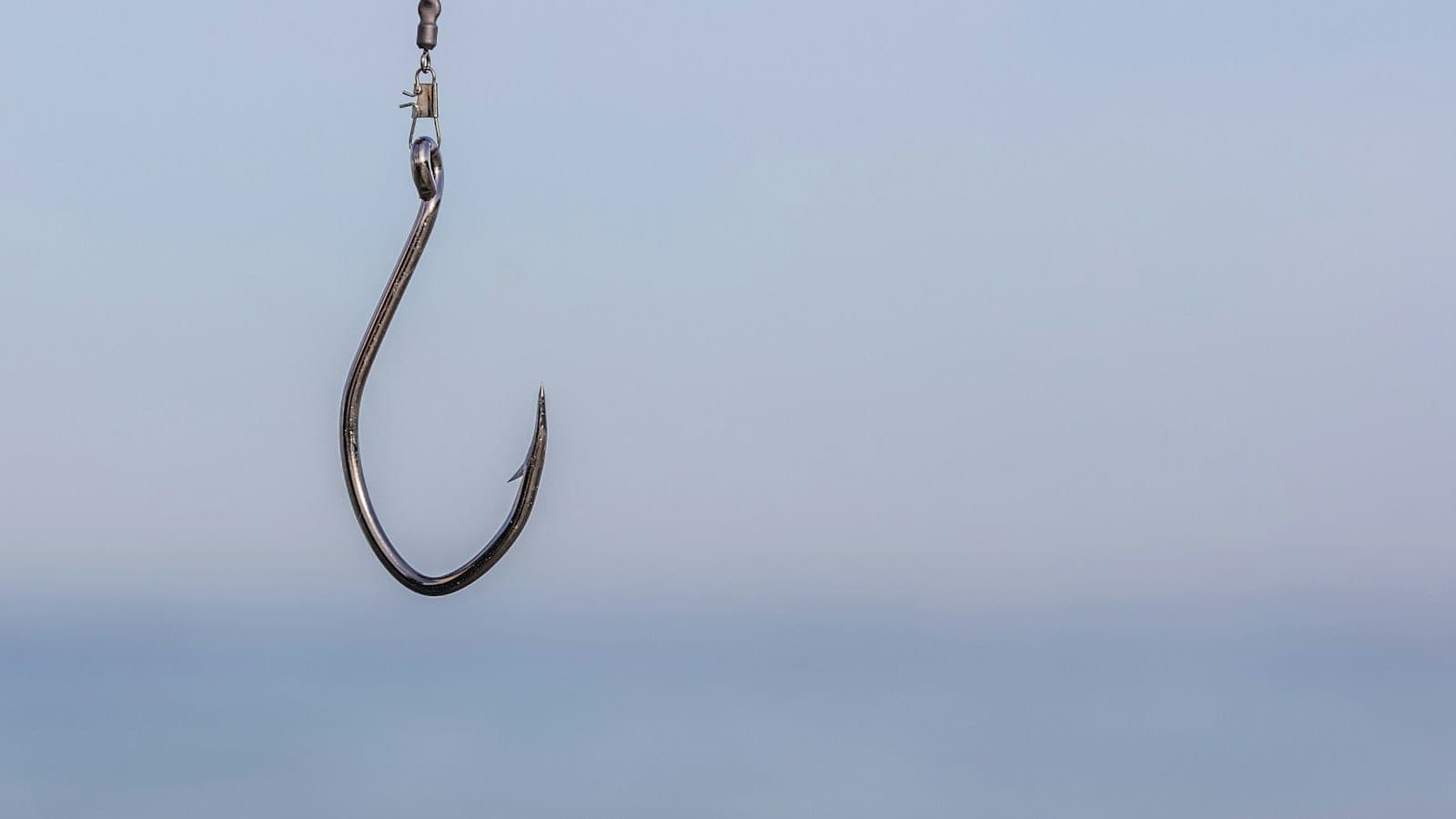
The hook is the one piece of tackle that actually holds the fish, yet the hook wall at a tackle shop can be the most confusing aisle in the store. Sizes count in two directions, every style has a name, and the packets talk about wire, gaps and points. This guide decodes it: how hook sizes work, what the common styles are for, how wire gauge and barbs change things, and how to keep a point sharp. It ends with a size chart by species so you can buy the right packs the first time.
The parts of a hook
Knowing the names makes the packet labels easy to read.
- Eye: where the line ties on. It can be straight, turned up or turned down.
- Shank: the straight length from the eye to the bend. A long shank is easier to unhook and holds long baits; a short shank is lighter and hides in the bait.
- Bend and gap: the curve, and the distance between the point and the shank. A wider gap leaves room for a thick soft plastic or a big bait and still hooks the fish.
- Point and barb: the point penetrates; the barb is the small backward spike that stops the hook sliding out.
How hook sizes count
Hook sizes run in two directions, which trips up almost everyone.
- Plain numbers count down as the hook gets bigger. A size 14 is tiny, a size 8 is a typical panfish hook, a size 2 is larger, and size 1 is the largest of the plain numbers.
- After size 1, the "aught" sizes count up. Next comes 1/0 (say "one-aught"), then 2/0, 3/0 and on to 10/0 and beyond. Here a bigger number means a bigger hook.
So the order from smallest to largest runs: 12, 10, 8, 6, 4, 2, 1, 1/0, 2/0, 3/0, 4/0. Only even numbers are common below size 1.
There is no single industry standard. A 2/0 from one brand can be noticeably larger than a 2/0 from another, and a 2/0 circle hook is shaped differently from a 2/0 octopus hook. Use sizes as a guide, and match the hook to the bait in your hand.
The common styles
J hooks and baitholders
The classic shape: a straight shank, a round bend and a point parallel to the shank. A baitholder is a J hook with small barbs cut into the shank to keep a worm or cut bait from sliding down. Use them for worms, cut bait and general bait fishing. Set the hook as soon as you feel the fish. Browse J hooks.
Aberdeen hooks
A long shank, a wide round bend and light wire. The long shank makes them easy to remove from small mouths, and the light wire hooks a live minnow without killing it. The wire also bends open under steady pressure, so you can often pull one free from a snag and bend it back. They are the standard crappie minnow hook. The Mustad Classic Aberdeen hooks in size 2 suit crappie on small minnows.
Octopus hooks
A short shank, a turned-up eye and a round bend with the point turned slightly in. They are compact and light, so they hide inside a bait and let a live bait swim naturally. Use them for live bait, for nightcrawlers on walleye rigs, for salmon and steelhead egg loops, and as the hook on a drop-shot rig in a pinch. The Gamakatsu Octopus hooks in size 2/0 suit larger live minnows and cut bait for bass and catfish; for walleye, go down to size 6 to 1.
Circle hooks
The point turns sharply back toward the shank. When a fish swallows the bait and swims off, the hook slides out of the throat and rolls into the corner of the jaw. That means fewer deep-hooked fish, which matters if you release them.
Circle hooks need a different hookset: do not jerk. When the rod loads, simply reel steadily and lift. A hard, early hookset pulls a circle hook out of the fish's mouth. Some saltwater fisheries now require inline (non-offset) circle hooks with natural bait for certain species, such as striped bass along the Atlantic coast, so check your local regulations. The FishTrip 2/0 circle hooks are a heavy 5X-strong wire suited to cut and live bait for inshore fish and catfish. Browse every size in circle hooks.
EWG and offset worm hooks
A worm hook has a bend (the offset) just behind the eye that locks the soft plastic in place. An extra-wide-gap (EWG) hook adds a wide gap so a thick plastic can collapse and still expose the point. Use them for Texas-rigged worms, creature baits and soft jerkbaits. Size 3/0 suits most 6- to 7-inch worms; 4/0 or 5/0 suits bulkier baits. The Gamakatsu EWG offset worm hooks in 4/0 suit creature baits and larger worms. Our guide to rigging soft-plastic worms shows how to rig one.
Treble hooks
Three points on one shank. Trebles come on crankbaits, jerkbaits, topwaters and spoons, and they hook fish that swipe at a moving bait. The usual reason to buy them is to replace dull or rusted hooks on a lure: match the size printed on the old hook, because a heavier or larger treble can change how the lure swims. Browse treble hooks.
Drop-shot hooks
A short shank, a straight eye and a wide gap, usually sizes 4 to 1/0. You nose-hook a small plastic through the tip of the head so it hovers and quivers above the weight. Many come in a dark finish to stay low-key in clear water. See drop-shot hooks.
Wacky hooks
A wide gap and a short shank, often with a small wire weed guard. Sizes 1 to 2/0 suit 4- to 5-inch stick baits hooked through the middle. Browse wacky and neko hooks.
Wire gauge and strength
Packets describe wire as fine, light, standard or heavy, or with an "X" number. "2X strong" means the hook is made of wire as thick as a standard hook two sizes larger. "2X long" means a longer shank in the same way.
- Light wire penetrates easily with light line and a soft rod, keeps live bait lively, and bends free from snags. It can straighten on a big fish or under heavy drag.
- Heavy wire holds big, strong fish and heavy drag settings, but needs a stiffer rod and stronger line to drive it home.
Match the wire to the line. A 2X- to 5X-strong hook on 6 lb line is hard to drive home, and a fine-wire Aberdeen on 50 lb braid can straighten before the line gives.
Barbed or barbless
Barbless hooks go in more easily and come out faster, which means less handling and less harm to fish you release. Some waters require them, including many fly-fishing-only streams and some salmon and trout fisheries; check your regulations. To make any hook barbless, flatten the barb with pliers. Keep a tight line on a barbless hook: slack lets it fall out. If you fish with kids, a pinched barb also makes an accident easier to deal with.
How to sharpen a hook
A sharp hook catches more fish, and points dull quickly on rock, shell and teeth.
- Test it. Rest the point on your thumbnail at a slight angle and drag it gently. A sharp point grabs; a dull one slides.
- File in one direction. Hold the hook steady and stroke a hook sharpener along the point in one direction only, a few light strokes at a time, rather than sawing back and forth.
- Shape three sides. File the outside and both sides of the point so they meet in a triangle. A triangular point cuts in more easily than a round one.
- Test again, and stop as soon as it grabs. Over-filing shortens and weakens the point.
The Luhr-Jensen hook file is a 4-inch file with a handle, sized for medium and large hooks. Many small, chemically sharpened hooks start out sharper than a file can make them, so plenty of anglers replace those rather than file them.
A size chart by species
These are common starting points for bait fishing. Go smaller for small baits or wary fish, larger for bigger baits.
| Species | Bait | Style | Size |
|---|---|---|---|
| Bluegill, sunfish | Worm piece, cricket | Aberdeen or baitholder | 10–6 |
| Crappie | Small minnow | Aberdeen | 6–2 |
| Trout (streams, lakes) | Worm, dough bait, eggs | Baitholder or octopus | 12–6 |
| Walleye | Minnow, nightcrawler | Octopus | 6–1 |
| Bass | Live minnow | Octopus or circle | 2–2/0 |
| Bass | Texas-rigged worm | EWG or offset worm | 2/0–5/0 |
| Channel catfish | Cut bait, chicken liver | Circle | 2/0–5/0 |
| Flathead or blue catfish | Live or cut bait | Circle | 6/0–10/0 |
| Redfish, inshore fish | Live shrimp, cut bait | Circle or octopus | 1/0–4/0 |
What to buy first
- A pack of size 6 Aberdeen or baitholder hooks for panfish.
- A pack of 1/0 to 2/0 octopus or circle hooks for bigger bait.
- A pack of 3/0 EWG worm hooks if you fish soft plastics.
- A hook file.
An assortment covers several sizes while you learn; see hook assortments or browse all hooks. To keep them sorted, read organizing a tackle box, and to tie them on, five fishing knots to learn first.