Technique · 8 min read
Swimbaits for beginners: paddle tails, soft jerkbaits, jointed baits and glide baits
The four kinds of swimbait, how to rig and retrieve each one, and the rod, reel and line that throw it.
Updated
First Cast Fishing earns a commission when you buy through links on this site, at no extra cost to you. Affiliate disclosure
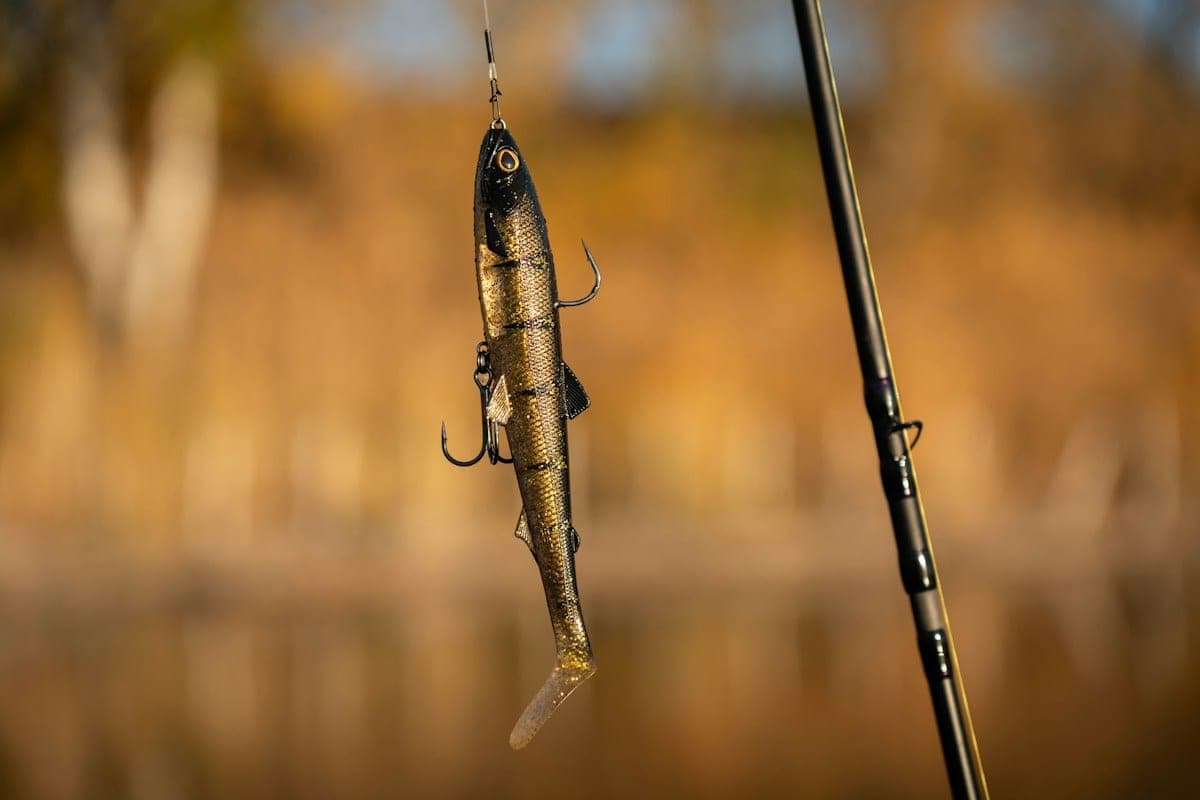
A swimbait is any lure built to look and swim like a real baitfish. That covers a lot of ground: a 3-inch soft plastic on a jig head, a weightless soft jerkbait darting under the surface and a 7-inch hard glide bait that sweeps from side to side. This guide sorts swimbaits into four groups: paddle tails, soft jerkbaits, multi-jointed hard baits and glide baits. For each one you will find the sizes to start with, how to rig it, how to reel it, and the rod that handles it. Start with paddle tails. They are the easiest to fish and they catch bass, walleye, pike, stripers and inshore saltwater fish.
The four kinds of swimbait
| Type | Typical size | Typical weight | Action | Where it shines |
|---|---|---|---|---|
| Paddle tail | 2.5–6 in | 1/8–1 oz with the head | Tail kicks on a steady retrieve | Open water, grass edges, rock, docks |
| Soft jerkbait | 4–6 in | Weightless, or 1/16–1/8 oz | Darts and glides when twitched | Shallow water, spawning areas, over grass |
| Multi-jointed | 3–6 in | 1/2–2 oz | S-shaped swim at slow speeds | Points, flats, shad schools |
| Glide bait | 5–10 in | 1–7 oz | Wide side-to-side glides | Clear water, big fish, sight fishing |
As a rule, smaller soft baits get more bites from fish of every size. Bigger hard baits get fewer bites, but the fish that do bite tend to be larger. Most anglers start small and work up.
Paddle-tail swimbaits
A paddle tail is a soft plastic baitfish with a flat, foot-shaped tail. When you reel it, the tail beats from side to side and the body rolls a little, which is all the action it needs. You do not have to work the rod at all.
Rigging on a jig head
The simplest rig is a swimbait jig head: a lead or tungsten head shaped like a baitfish's, with a hook that comes out of the top of the bait's back.
- Match the hook to the bait. A 3/0 hook suits most 3- to 4-inch paddle tails; 4/0 or 5/0 suits 4.5 to 5.5 inches.
- Pick the weight by depth and speed: 1/8 oz for water under 6 feet, 1/4 oz for 5 to 15 feet, 3/8 to 1/2 oz for deeper water, current or wind.
- Thread the bait onto the hook so it sits straight against the head. A crooked bait rolls over and twists your line.
The Keitech Fat Swing Impact is a 3.8-inch paddle tail with a thick body, a size that suits bass and walleye. It pairs with a head like the VMC swimbait jig, a 1/4 oz head with a 3/0 hook.
An exposed hook hangs up in heavy cover. For grass, wood and docks, rig weedless instead.
Rigging weedless on a weighted swimbait hook
A weighted swimbait hook has a wide gap, a weight molded onto the shank under the bait's belly and a spring or screw keeper that holds the bait's nose. The point goes back into the bait's back, Texas style, so the bait comes through cover.
- Screw the keeper into the center of the bait's nose until the nose sits against the hook eye.
- Lay the hook alongside the bait to see where the point meets the back.
- Push the point up through the belly at that spot and out through the back, then tuck the tip just under the plastic, or leave it lying flat in a slot if the bait has one.
The Owner Beast hook with TwistLOCK is a 4/0, 1/8 oz version of this hook, sized for paddle tails of about 4.5 to 5 inches. The belly weight keeps the bait upright and swimming level instead of rolling.
Retrieving a paddle tail
- Steady retrieve. Cast, count it down to the depth you want (roughly a foot per second on a 1/4 oz head, though bait size, line and head shape change it), then reel just fast enough for the tail to kick. This is the retrieve most bites come on.
- Bump the bottom. Let the bait reach the bottom, then reel so it lifts, and let it touch down every few turns. Good for walleye and fish holding on rock.
- Slow roll over grass. Reel just above the weed tops so the bait ticks them now and then.
Paddle tails work all season, but they shine when bass and walleye chase shad and shiners: before the spawn in spring, and in the fall.
Soft jerkbaits
A soft jerkbait is a slender soft plastic minnow with a thin or forked tail and no paddle. It does nothing on its own. Twitch the rod tip and it darts to one side, then the other, and glides to a stop.
- Size: 4 to 5 inches for bass, 5 to 6 inches in saltwater.
- Hook: a 3/0 to 5/0 EWG or offset worm hook, rigged Texas style and weightless. A small weighted hook helps in wind or when fish are a few feet down.
- Retrieve: two or three sharp twitches on a slack line, then a pause of one to three seconds. Most strikes come on the pause.
The Z-Man Jerk ShadZ is a 5-inch scented soft jerkbait, the size to start with for bass on a 4/0 or 5/0 hook. Fish soft jerkbaits shallow: around spawning beds, over grass that is a foot or two under the surface, and wherever fish are chasing baitfish on top.
Multi-jointed hard swimbaits
A multi-jointed swimbait is a hard plastic body cut into several sections joined by pins or wire, usually with two or three treble hooks. Each joint flexes, so the bait swims in a smooth S-curve even at slow speeds.
- Size: 3 to 6 inches and about 1/2 to 2 ounces. Start around 4 to 5 inches.
- Float or sink: most are slow-sinking, so you count them down; some float and run shallow.
- Retrieve: slow and steady. Reel just fast enough to see the body snake, and pause now and then. Reeling fast makes many of them roll out.
Treble hooks catch on everything, so keep these to open water: points, flats, the edges of grass lines and the open water where shad gather.
Glide baits
A glide bait is a hard bait with one joint, sometimes two, built to swing wide to each side with a long, slow glide. Big bass, pike and muskie come up for it, often from a long way off.
- Size: 5 to 7 inches and 1 to 3 ounces for most bass water; 8 to 10 inches and 4 to 7 ounces in big-fish lakes.
- Retrieve: slow turns of the reel handle, or short sweeps of the rod with the slack reeled up between them. Each sweep sends the bait gliding to one side; the next sends it to the other. Pause often and let it sit.
- Follows: fish often follow a glide bait without biting. Change the cadence when you see one: pause, give one hard turn of the handle, or make it turn sharply near the boat.
The Savage Gear 3D Glide Swimmer is a 6.5-inch, 1.75 oz glide bait, a mid-size choice that a heavy bass rod can still throw. Glide baits are at their most useful in clear water, where fish can see them from a distance.
Rods, reels and line for each
| Bait | Rod | Reel | Line |
|---|---|---|---|
| Paddle tail, 1/8–1/4 oz | 7'0" medium spinning, fast action | 2500–3000 spinning | 10–15 lb braid, 8–12 lb fluorocarbon leader |
| Paddle tail, 3/8–1 oz, weighted hook | 7'0"–7'3" medium-heavy casting, fast action | Baitcaster, 7:1 or so | 15–20 lb fluorocarbon, or 40–50 lb braid around grass |
| Soft jerkbait | 6'10"–7'2" medium spinning or medium-heavy casting | Spinning or baitcaster | 10–15 lb braid with a fluorocarbon leader, or 12–15 lb fluorocarbon |
| Multi-jointed | 7'0"–7'6" medium-heavy casting, moderate-fast action | Baitcaster | 15–20 lb fluorocarbon |
| Glide bait, 1–3 oz | 7'6"–8'0" heavy casting | 200- to 300-size baitcaster | 20–25 lb fluorocarbon, or 50–65 lb braid with a fluorocarbon leader |
| Glide bait, 4 oz and up | 8'0" extra-heavy swimbait rod | 300- to 400-size baitcaster | 25 lb fluorocarbon or heavier |
A softer tip helps with treble-hooked baits, because fish stay pinned while the rod bends. A stiff, fast rod suits single-hook baits, because you need to drive the hook through the plastic. For what those power and action terms mean, see rod power and action explained. For line choices, see mono, fluoro or braid.
Pike and muskie have sharp teeth that can cut through light line. Where they live, add a wire or heavy fluorocarbon leader; see swivels, snaps and leaders.
Colors and a starter set
Swimbaits imitate baitfish, so match the local forage first: shad and shiner whites and silvers in most lakes, bluegill patterns near weed beds, and trout colors in lakes stocked with trout. In stained water, a chartreuse back or a darker body is easier for fish to find. For more on this, read matching lure color to water clarity.
To start, carry:
- A pack of 3.5- to 4-inch paddle tails in a white or shad color.
- A few 1/4 and 3/8 oz swimbait jig heads with 3/0 to 4/0 hooks.
- A few 4/0 weighted swimbait hooks for weedless rigging.
- A pack of 5-inch soft jerkbaits and some 4/0 EWG hooks.
- One 4- to 5-inch multi-jointed bait or one 5- to 6-inch glide bait, once you have the rod for it.
For more on choosing heads, see choosing jig heads and sinkers for soft plastics, and browse every style in swimbaits.