Technique · 7 min read
Tip-ups explained: setting them for pike, walleye and trout
How tip-ups work, how to rig and set them for pike, walleye and trout, and how to space them, alongside tip-downs and wireless alerts.
Updated
First Cast Fishing earns a commission when you buy through links on this site, at no extra cost to you. Affiliate disclosure
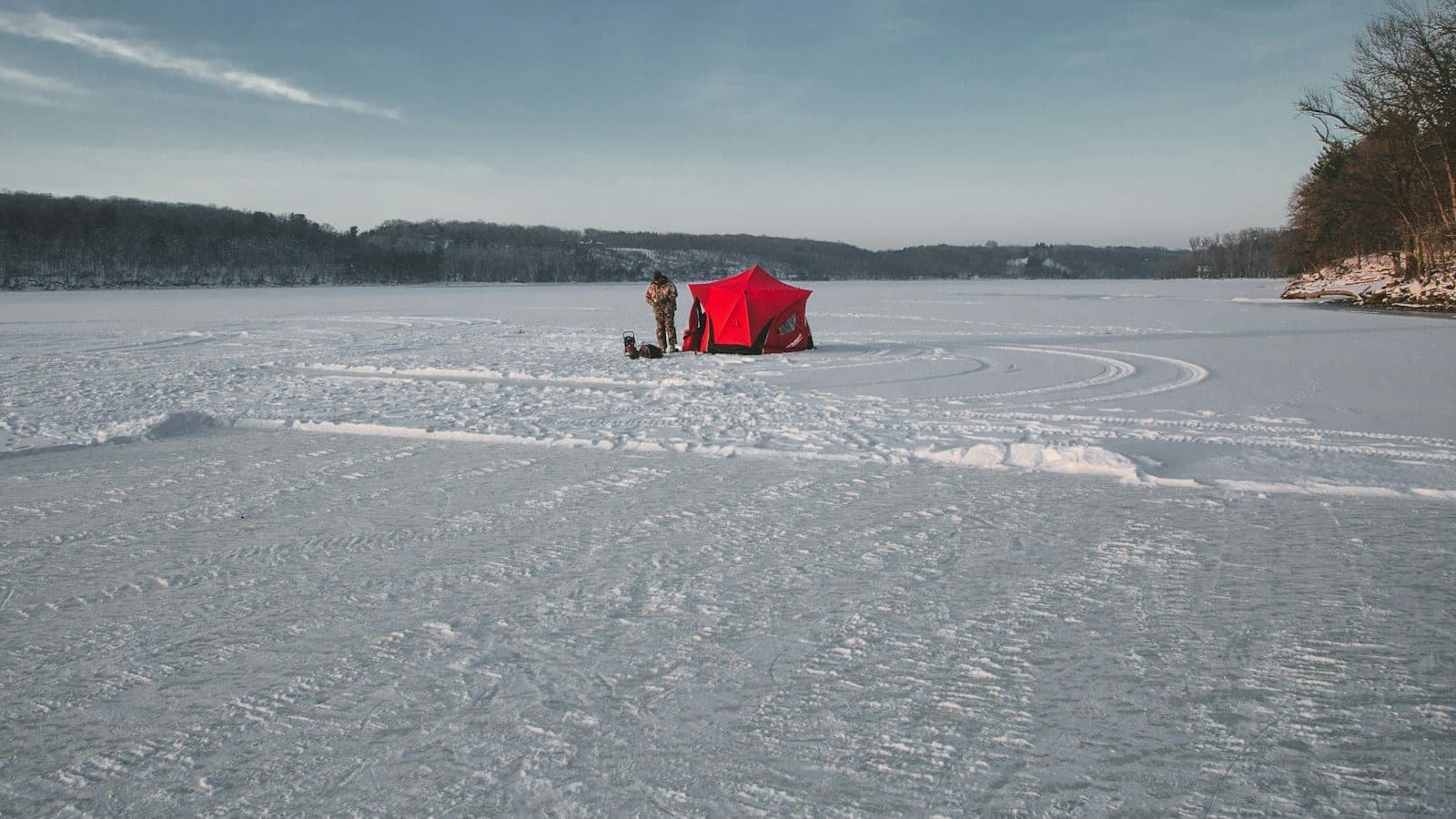
A tip-up is a simple frame that sits over a hole in the ice and holds a baited line at a set depth. When a fish takes the bait and pulls line, a flag springs up, and you walk over and pull the fish in by hand. Tip-ups let you fish several holes at once while you jig in another, and they are the classic way to catch pike through the ice, as well as walleye and trout. This guide covers how they work, wood versus thermal models, rigging for each species, setting the depth, spacing, and the tip-downs and wireless alerts that do the same job in different ways.
How a tip-up works
Every tip-up has three parts:
- A frame or base that rests on the ice across the hole.
- A spool of line on a shaft that hangs down into the hole or sits just above it.
- A spring-steel flag that is bent over and held down by a trip on the spool shaft.
When a fish swims off with the bait, the spool turns, the trip releases the flag, and it pops upright where you can see it from across the ice. Most tip-ups let you set the trip light or heavy, often by flipping a T-bar or choosing one of two notches. Use the light setting for cautious biters such as walleye and trout, and the heavy setting when the wind is strong or a lively bait keeps tripping the flag.
Wood or thermal tip-ups
Wood (cross-frame) tip-ups have two crossed wooden arms that rest on the ice over the hole and an upright that carries the flag and the spool, which hangs on its shaft below the ice. Because the spool sits underwater, it does not freeze, but the open hole around the shaft does skim over on cold days. They fold flat and pack into a bucket. The Frabill Classic wood tip-up has a 17.5-inch flag and a spool that holds 200 to 300 yards of line, plenty for a pike that runs.
Round thermal tip-ups have a wide plastic base that covers the whole hole. The cover keeps snow and light out and slows the hole from freezing, which helps in deep cold and on windy days when you are not checking holes often. Some, like this foldable thermal tip-up, fold down for carrying. A round base needs a hole no larger than its cover, so check the size against your auger.
Whichever kind you use, bring an ice scoop to keep holes clear. Browse all tip-ups.
Line: backing and leaders
A tip-up line has two parts joined by a small barrel swivel.
Backing is the main line on the spool. Use 20 to 30 lb tip-up line, a braided line, often coated, that is easy to grab with cold hands and sheds water so it freezes less on the ice. You rarely need more than 50 to 100 yards, even on a spool that holds more. Sufix V-Coat tip-up braid is a 20 lb coated braid made for this, on a 50-yard spool. Find more in ice fishing line.
The leader goes between the swivel and the hook. It is less visible than the backing, and for pike it also has to survive teeth.
- Walleye and stream trout: 2 to 4 feet of fluorocarbon, 6 to 10 lb for walleye and 4 to 6 lb for stocked rainbows and brookies.
- Lake trout: 2 to 4 feet of 10 to 15 lb fluorocarbon.
- Pike: 12 to 24 inches of light wire or 30 to 50 lb fluorocarbon. Wire stops bite-offs; heavy fluorocarbon is less visible in clear water but can be cut by a big fish.
Pinch a split shot or two 12 to 18 inches above the hook to keep the bait down. See swivels, snaps and leaders and five fishing knots to learn first for the connections, and leader material for wire and fluorocarbon.
Hooks: quick-strike rigs or a single hook
A quick-strike rig has two small treble hooks on a wire leader, one in the bait's back and one near its head. Because both hooks sit in the bait, you can set the hook while the fish is still running with it instead of waiting for it to swallow the bait. That keeps hooks out of the pike's throat, which matters if you release fish. Quick-strike rigs suit larger baits: 5 to 8-inch suckers, shiners or dead smelt and herring where dead bait is legal.
A single hook is simpler and suits smaller baits. Hook a 2 to 4-inch fathead or shiner lightly through the back or the lips on an octopus or circle hook, size 6 to 2 for walleye and 8 to 6 for trout. With a single hook, give the fish a moment after the flag goes up so it can turn the bait, then set. With a circle hook, just pull steadily and let the hook find the corner of the mouth.
Browse treble hooks, octopus hooks and circle hooks, and read fishing hooks: sizes and styles for how hook sizes run.
Setting the depth
- Clip a heavy depth-finding weight to the hook and lower it until the line goes slack on the bottom.
- Reel or wind up the amount you want off the bottom.
- Mark that depth with a bobber stop on the line at the spool, so you can rebait and reset at the same depth.
- Remove the weight, add the bait and lower it back down.
Starting depths, by species:
| Species | Bait | Starting depth |
|---|---|---|
| Pike | 5–8 in sucker, shiner or dead smelt | 2–4 ft below the ice over weeds, or a few feet off bottom on drop-offs |
| Walleye | 2–4 in fathead or shiner | 1–2 ft off the bottom |
| Lake trout | 3–5 in shiner or cisco | Near the bottom in deep water |
| Rainbow and brook trout | 2–3 in shiner | 2–6 ft below the ice |
These are starting points; raise or lower the bait if you are marking fish at another depth or not getting flags.
Where and how far apart
Spread tip-ups to cover different water: one on the edge of a weed bed, one on the drop-off below it, one shallower on the flat. Space them far enough apart that you are not fishing the same fish twice, often 20 to 50 yards, but close enough to see every flag and reach it quickly. In poor light or snow, keep them closer.
Check your local regulations before you set a single tip-up. States and provinces set how many lines one angler may fish at once (it varies from two to more than five), whether tip-ups must be within sight or a set distance of you, whether they must carry your name, and whether dead bait or certain baitfish are allowed. The rules can differ from lake to lake.
When the flag goes up
- Walk, do not run. Ice is slippery.
- Look at the spool. If it is turning, a fish is moving off with the bait.
- With a quick-strike rig, lift the tip-up out and set the hook with a firm pull on the line. With a single hook on a walleye, wait until the spool stops and starts again, then set.
- Pull the fish in hand over hand, and let line slip through your fingers if it surges. Keep the line off sharp ice.
- Guide the head into the hole first. With pike, use long pliers or a jaw spreader to take out hooks.
Tip-downs and wireless alerts
A tip-down is a stand that holds your rod and reel on a balanced pivot over the hole. When a fish pulls, the rod tips down into the hole. You fight the fish on the rod, with the reel's drag, which suits walleye, perch and trout on lighter line. The Big RED tip-down is a tall steel-frame tip-down for this.
Wireless alerts clip to a tip-up and send a signal when the flag trips. The Deep Freeze BlueTipz are Bluetooth transmitters, sold in pairs, that alert your phone, which helps when you are inside a shelter and cannot watch every flag.
Pair two or three tip-ups with a jigging rod and the ice lures in your bucket, and you cover far more water than jigging alone.