Buying guide · 8 min read
Your first surf fishing setup
The rod, reel, line, sinkers and rigs to fish from the beach, plus the bait to use and how to find fish in the waves.
Updated
First Cast Fishing earns a commission when you buy through links on this site, at no extra cost to you. Affiliate disclosure
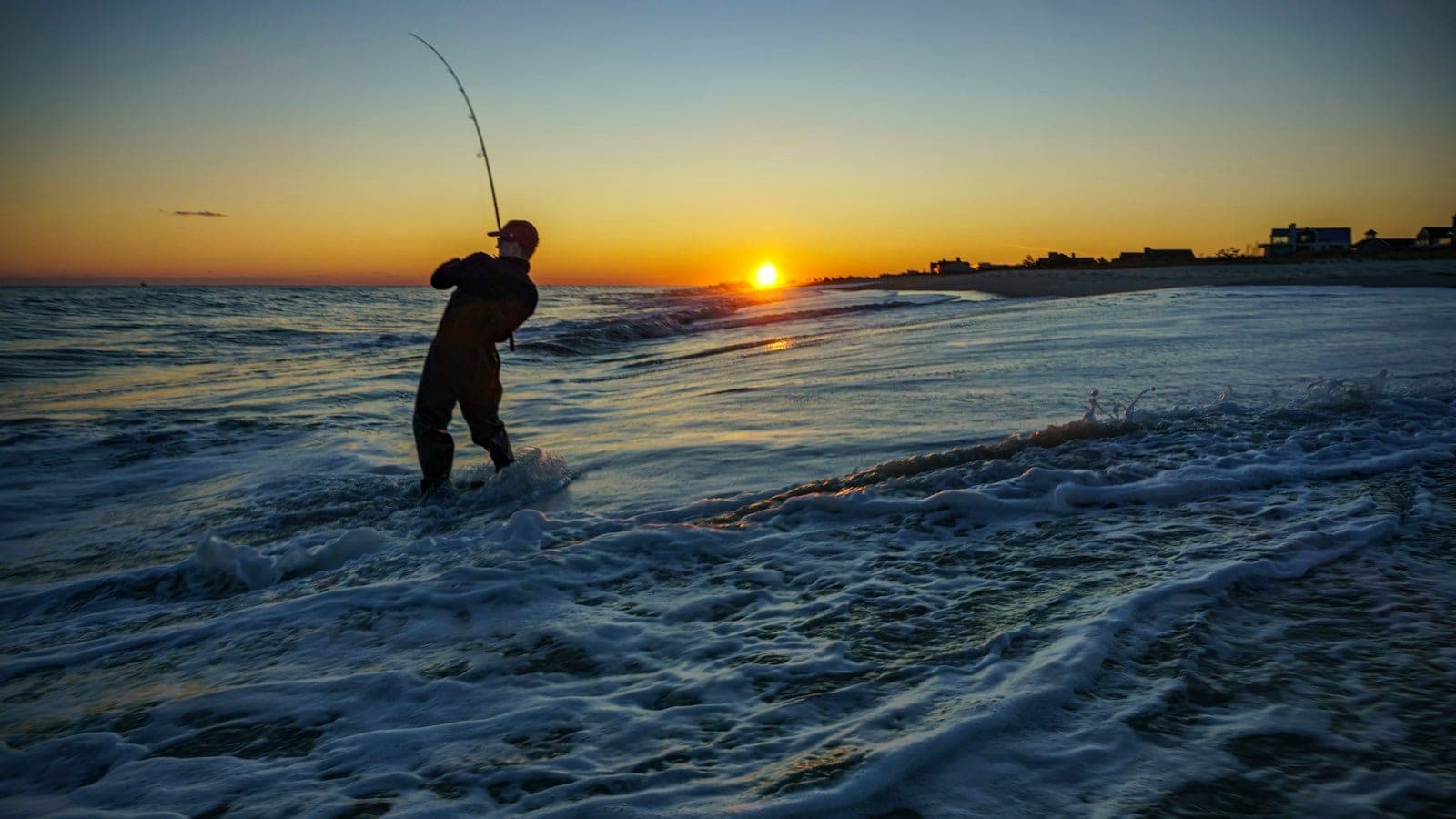
Surf fishing looks simple: cast a bait past the waves, stand the rod in the sand and wait. But the rod has to throw a heavy sinker a long way, the sinker has to hold against waves and current, and the rig has to keep the bait where fish feed. This guide covers a first setup for sandy beaches, from rod and reel to bait, and how to read the beach so you cast to fish rather than empty water.
The rod: 9 to 12 feet
Length means distance, and a tall rod held high keeps your line above the first breaking waves.
| Length | Sinker weight | Good for |
|---|---|---|
| 8–9 ft | 1–3 oz | Calm beaches, pompano, whiting and surfperch close in, kids and smaller anglers |
| 10–11 ft | 2–6 oz | Most beaches; the all-round choice for a first rod |
| 12 ft and up | 4–8 oz | Heavy surf, strong current, big baits, long casts for striped bass and big drum |
For a first rod, a 10-foot medium-heavy spinning rod built for sinkers of about 2 to 6 oz suits most sandy beaches on the Atlantic and Gulf coasts; Pacific surfperch anglers often go lighter. The Penn Squadron III surf rod is a 10-foot medium-heavy spinning rod for 15 to 30 lb line.
Look for a long butt section between the reel and the end of the handle, which you need to cast two-handed. Two-piece rods travel more easily; a 10- to 12-foot one-piece will not fit in most cars. For more on what the ratings mean, see rod power and action explained. Browse more surf rods.
The reel
A spinning reel is the easiest start; a conventional casts farther in practiced hands but backlashes more. Size it to the rod:
- 8 to 9 ft rods: a 4000 to 5000 size spinning reel.
- 10 to 11 ft rods: a 5000 to 6000 size.
- 12 ft rods: a 6000 to 8000 size.
Sizes vary by brand, so compare line capacity: you want at least 200 yards of main line. Choose a saltwater reel with sealed or corrosion-resistant bearings, and rinse it with fresh water after every trip; reel maintenance: cleaning, oil and grease covers the routine.
A matched surf combo saves the pairing. The Sougayilang surf combo pairs a 9-foot, three-piece medium-heavy rod with a baitfeeder reel, which lets a fish run with the bait on a free spool while the rod sits in a spike; at 9 feet it suits calmer beaches.
Line and shock leaders
Main line. Either works:
- Braid, 20 to 30 lb. Thin for its strength, so it casts farther and cuts through current, and with no stretch you feel bites clearly. It needs a leader.
- Monofilament, 15 to 20 lb. Forgiving, simpler to tie, and its stretch cushions a fish in the waves, but it casts less far.
Shock leader. A 3 or 4 oz sinker loads the line hard at the moment of the cast, and thin line can snap and send the sinker flying, a danger to anyone nearby. A shock leader is heavier line that takes that load. The common rule is about 10 lb of leader for every ounce of sinker, so 40 lb for a 4 oz weight. Make it long enough to run from the sinker through the guides and around the spool several times when you cast, about twice the rod length.
Join braid to the leader with an FG knot, which slides through the guides, or a uni-to-uni, both in five fishing knots worth learning first. Look for 30 to 60 lb monofilament or fluorocarbon in leader material.
Sinkers: pyramid and bank
The surf pushes a light, round sinker back up the beach; a sinker that grips the sand keeps your bait in place.
- Pyramid sinkers dig a flat edge into the sand: the standard beach weight. Start with 2 and 3 oz and add 4 oz for rough days. A pack of 3 oz pyramid sinkers from Bullet Weights covers a lot of beach fishing.
- Sputnik or breakaway sinkers have wire legs that anchor in strong current and fold back when you reel in. Use them when a pyramid will not hold.
- Bank sinkers are smooth and teardrop-shaped. They roll more than a pyramid, letting a bait move slowly in light surf, and snag less over rock and around piers and jetties.
If your sinker keeps washing in, go heavier or switch to a sputnik. If it holds easily, go lighter, which casts farther. Browse pyramid sinkers and bank sinkers.
Surf rigs
The pompano or double-drop rig (also called a hi-lo rig) has two short dropper arms above a snap for the sinker. Each carries a small hook, often with a bright float or beads to lift the bait and catch a fish's eye. Use it for pompano, whiting, croaker, surfperch and other fish that feed on small crabs and clams. The Sea Striker pompano double-drop rig has two drops with 2/0 circle hooks.
The fish-finder rig suits bigger fish such as red drum, striped bass and bluefish. Slide a sinker slide (or an egg sinker) onto the main line, tie on a barrel swivel as a stop, then tie 18 to 30 inches of leader to the swivel with a 5/0 to 8/0 circle hook. A fish can take the bait without feeling the weight. For bluefish, add a short wire section; swivels, snaps and leaders: when you need them covers when wire is worth it.
Circle hooks are a good default on both rigs, and many Atlantic coast states require them when you fish bait for striped bass. Do not set the hook hard: let the rod load as the fish swims off and the hook turns into the corner of the mouth. Fishing hooks: sizes and styles explains hook sizes. Pre-tied surf and pompano rigs save time on a windy beach.
Sand spikes and rod holders
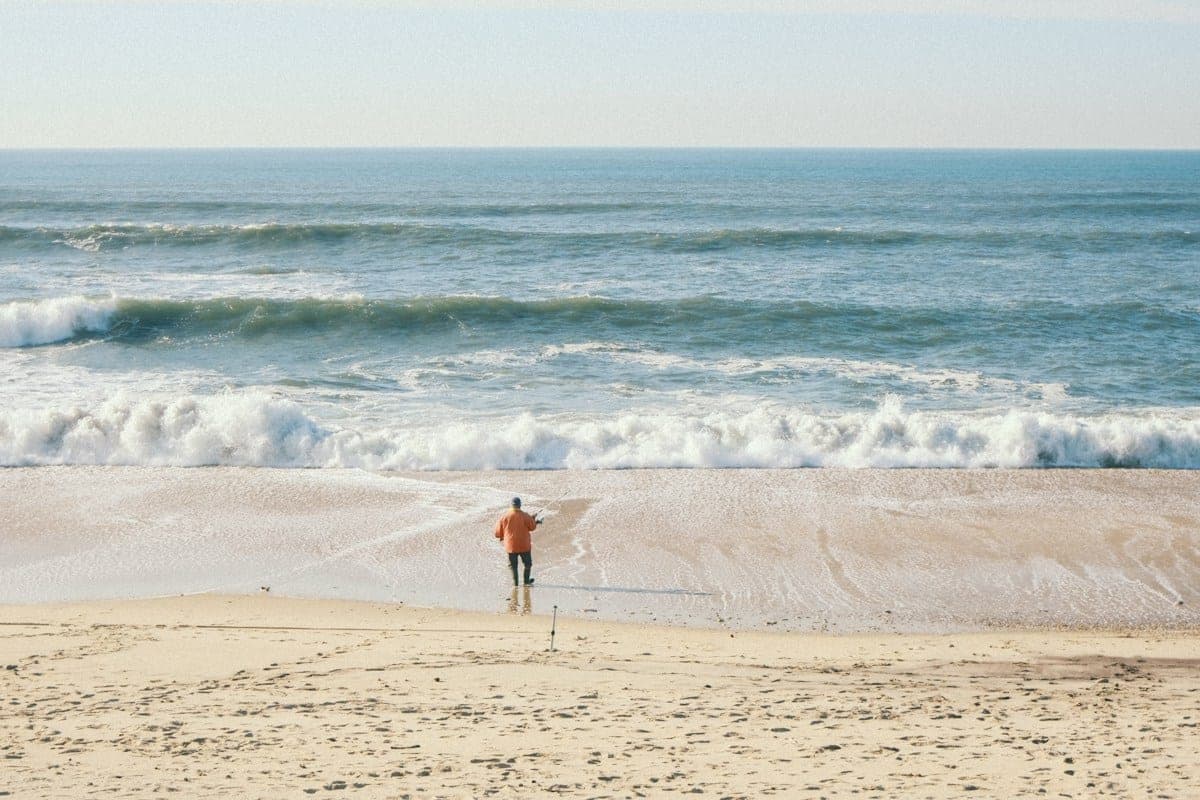
You cannot hold a 10-foot rod for hours while you wait. A sand spike is a tube of PVC or aluminum, usually 3 to 4 feet long, that you push into the sand to hold the rod upright.
- Push it in at least a foot deep, above the wet sand where waves wash up.
- Stand the rod nearly upright so the line stays high over the breakers.
- Keep the line tight enough that the tip bends slightly. A bite shows as a sharp bounce, or the tip straightening when a fish picks up the sinker and swims toward you.
The Sea Striker PVC sand spike is a 36-inch PVC tube with an aluminum stop pin that holds the rod butt at a set height. For other rod holders and bite bells, browse bank and pier gear.
Bait
Fresh, local bait usually outfishes anything else; ask at the nearest tackle shop what is working. Common choices:
- Sand fleas (mole crabs): dig them from the wet sand where waves wash back. The natural food of pompano, whiting, drum and surfperch.
- Shrimp: fresh or frozen, peeled and cut into pieces. Catches nearly everything.
- Cut bait: strips or chunks of mullet, menhaden (bunker) or mackerel for drum, bluefish, striped bass and sharks.
- Clams: a striped bass and drum bait on many Atlantic beaches.
- Bloodworms and sandworms: for whiting, croaker and striped bass.
- Artificial baits: scented shrimp- and crab-flavored strips hold up on the hook and store easily. Find them in preserved and artificial bait.
Keep bait in a cooler. Rebait every 15 to 20 minutes, even without bites; crabs and small fish strip hooks quickly.
Reading the beach
Fish in the surf follow the shape of the bottom; walk the beach at low tide to see it.
- Troughs are the deeper, darker strips of water between the beach and a sandbar. Fish cruise them for food knocked loose by the waves. The first trough is often only 20 to 40 yards out.
- Sandbars show as lines where waves break offshore. Cast to the edges of a bar rather than onto the top of it.
- Cuts are gaps in a bar where water drains back to sea, and they often hold rip currents: never wade into one. Fish the edges of a cut, where bait gets swept out.
- Points and holes in the shoreline, and the water around jetties and piers, concentrate fish too.
Many anglers do well on a rising tide, the two hours either side of high tide, and around dawn and dusk. A moderate surf that stirs the bottom often fishes better than a flat calm.
Safety and rules
Stay out of the water above your knees, watch for rogue waves, and keep an eye on the tide so it does not cut you off. Look behind you before every cast. Most coastal states require a saltwater license and set size and bag limits; check your state's rules.
A first-trip checklist
- A 10-foot surf rod and a 5000 to 6000 size spinning reel, or a matched surf combo
- 20 to 30 lb braid or 15 to 20 lb mono, with a 40 lb shock leader
- Pyramid sinkers in 2, 3 and 4 oz
- A few pompano rigs and fish-finder rigs with circle hooks
- One or two sand spikes
- Fresh bait in a cooler, plus pliers, a knife and a towel
- A headlamp if you stay for dusk